When children do not get enough iron in their food, the results are heartbreaking. They are slower to acquire language, struggle with short-term memory, have poor attention spans and ultimately do less well at school.
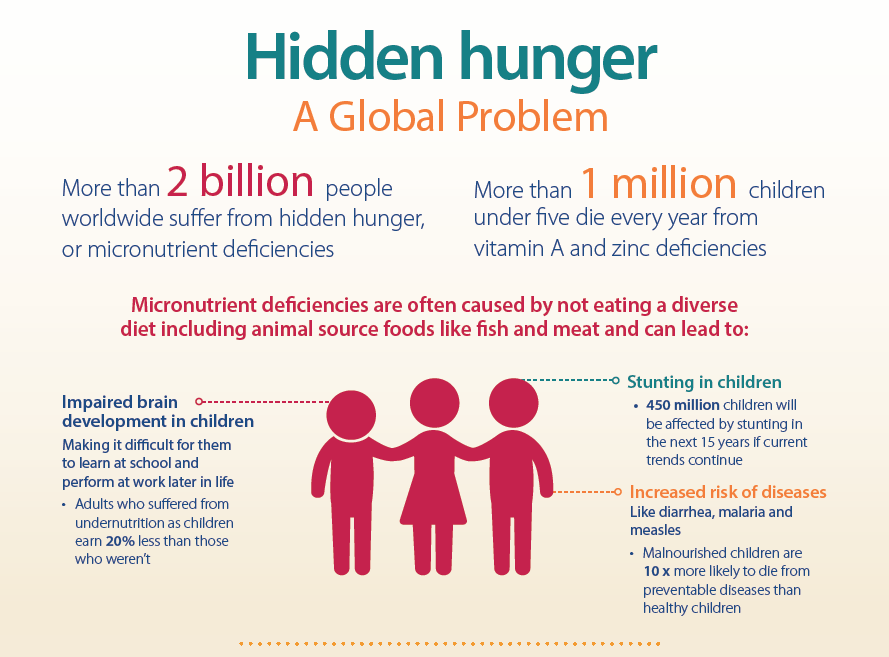
“They can never live up to their full physical and mental potential,” says Wolfgang Pfeiffer, director of research and development at HarvestPlus, an organisation that develops nutritionally improved crops in Washington DC. “If they are deficient in their childhood, they learn 20% less as adults.”
In the poorest parts of India and China, millions of children have their lives stunted through lack of iron. In South Asia, an estimated 50% of pregnant women have iron deficiency, and it is also prevalent in South America and sub-Saharan Africa.
But iron is only one small part of the story. There are several dozen other “micronutrients” – substances that we need to consume, in small quantities but regularly, to remain healthy. They include zinc, copper, vitamins and folates such as folic acid and vitamin B9.
An estimated two billion people – 30% of the global population – lack one or more crucial micronutrients. Many people suffer serious and life-long health problems as a result.
As the world’s population continues to grow rapidly, it becomes more pressing not just to increase the quantity but to improve the quality of foods. Without adequate levels of micronutrients, health problems like stunting, birth defects and blindness become a greater risk.